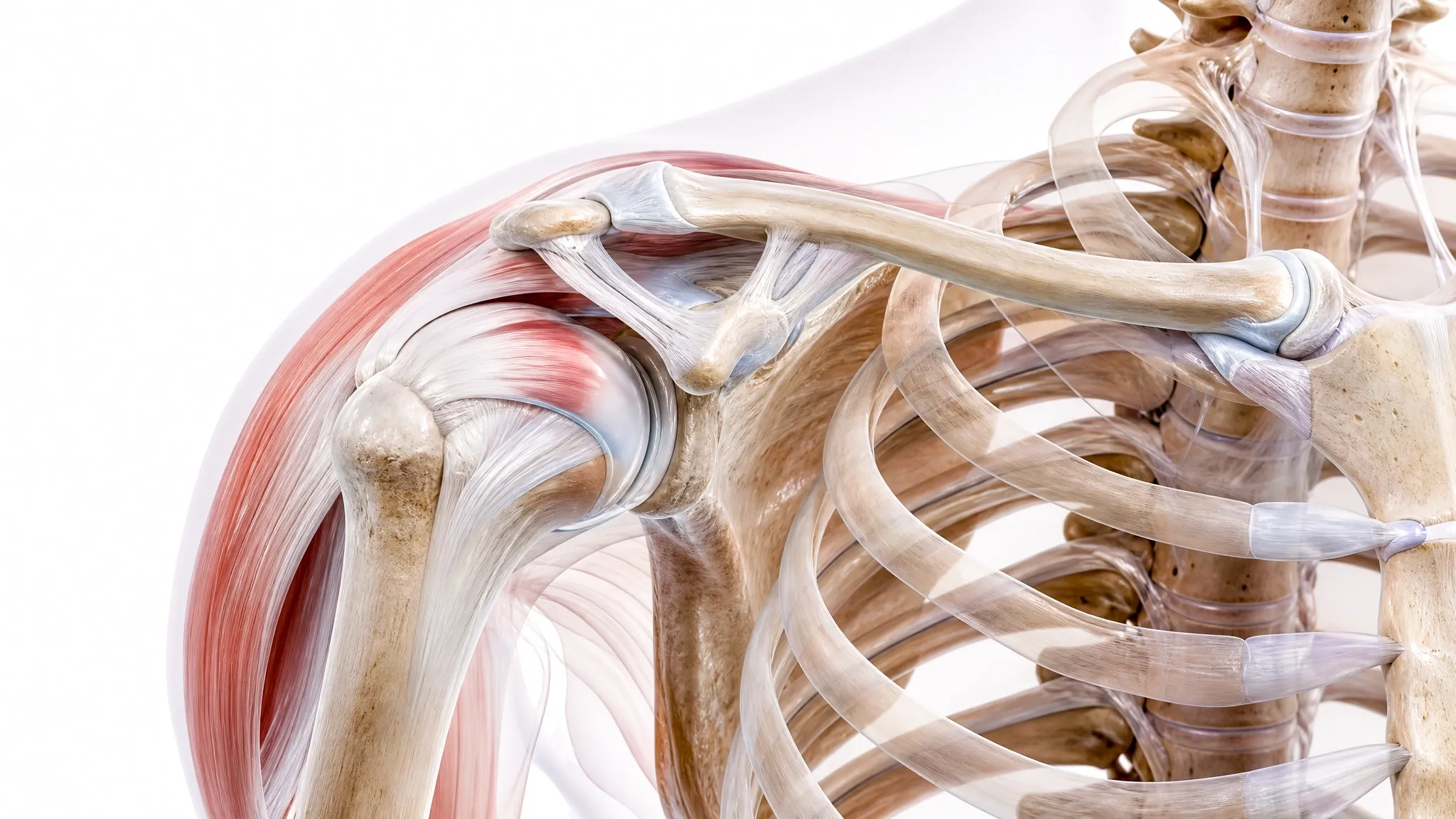
A 38-year-old man with a right shoulder that had been hurting for six months. The pain woke him at night, which anyone with a bad shoulder will recognise as the symptom that wears you down fastest, and he could no longer lift his arm out to the side properly. An MRI was ordered and it found something concrete: a partial tear of the supraspinatus tendon, one of the rotator cuff tendons, involving about 40 percent of its thickness.
There was now a word on the scan report that changes how everyone in the room thinks. Tear. It sounds like damage that must be repaired, like a rip in fabric that will only get worse if left alone. Surgery was recommended, and a date was booked for an arthroscopic reconstruction.
But a partial tear is not a rip in fabric, and this is the part patients are rarely told clearly. Sixty percent of that tendon was still intact and still working. The shoulder is not held together by one tendon alone but by a group of them, supported by the muscles that position and stabilise the shoulder blade behind it. A tendon that is partly torn can often still do its job, particularly if the rest of the system around it is trained to take up the slack. The scan describes the tissue. It does not describe what the shoulder is capable of.
If a scan has found a partial tear and surgery has been offered, it is worth asking whether a proper course of physiotherapy has been tried first, because structure and function are not the same thing.
Understanding shoulder pain of this kind helps in judging what to do about it:
- Pain on the outer upper arm rather than deep inside the joint, often worse when reaching or lifting
- Night pain, particularly when lying on the affected side, which is characteristic of rotator cuff problems
- Difficulty lifting the arm out to the side or overhead, with a painful arc partway through the movement
- Weakness with certain specific movements rather than general weakness of the whole arm
- Pain when reaching behind the back, such as fastening a seatbelt or a bra strap
- A gradual onset over months without a single dramatic injury
What matters most is the distinction between a shoulder that cannot move because the tendon has failed completely, and one that hurts and is inhibited but still functional. The second kind very often recovers without surgery.
What the first opinion concluded
His first assessment came from shoulder surgery, which established an indication to operate and scheduled the procedure.
A rotator cuff tear on a scan, in a patient with genuine pain and restricted movement, is a recognised reason to consider surgery, and for the right tear surgery works well.
The difficulty is the leap from finding to operation. Partial tears are common, and they are also frequently found in people with no shoulder pain at all, particularly as tendons age. That means the presence of a partial tear on an MRI does not by itself establish that the tear is what hurts, nor that repairing it is the only way to make the shoulder work again. For a partial tear of this kind, structured rehabilitation is widely regarded as a reasonable first step, and it had not been tried. Booking the operation first meant choosing the irreversible option before the reversible one had been given a chance.
The second opinion
He sought a medical second opinion from sports medicine and a shoulder specialist, and the recommendation was not a smaller operation. It was a different strategy altogether: four months of structured physiotherapy, built around two things in particular.
- Eccentric strengthening, a specific way of loading the tendon while it lengthens under control, which is well established for building tendon capacity and tolerance
- Scapular stabilisation, training the muscles that control the shoulder blade, so that the whole shoulder mechanism moves correctly and the cuff is not overloaded
This is not rest, and it is not passive treatment. It is progressive, deliberate loading over months, and it demands commitment from the patient, which is precisely why it is sometimes dismissed as the softer option when in fact it is the harder one to see through.
He completed the programme. After four months he had full shoulder function and no symptoms. He never had the operation.
The most interesting part is what did not happen. The partial tear is still there. It was never repaired. His shoulder works and does not hurt, with the same tear on the same tendon that had justified scheduling surgery. The tear had not been the problem in the way everyone assumed.
Why this case matters
The lesson is one this series keeps arriving at from different directions.
A partial tear does not automatically mean an operation. Structure and function are not the same thing, and a patient does not operate on the MRI report.
An image gives us something visible and definite, and that makes it feel like proof. But what a patient actually wants is a shoulder that works without pain, and that outcome depends on the whole system, muscles, control and load tolerance, not only on the state of one tendon on a scan. Honest communication in healthcare means explaining that a finding on an image is not automatically the cause of the symptoms, and that a reversible option deserves a genuine trial before an irreversible one is booked.
A word of balance
This is not an argument against rotator cuff surgery. Complete tears, especially traumatic ones in younger, active people, often do need repairing, and delaying can make the tendon harder to fix later. Some partial tears fail conservative treatment and go on to surgery, which is a perfectly good outcome and not a wasted four months. The narrow, practical point is about sequence: for a partial tear with a functioning shoulder, structured rehabilitation deserves a real trial first, because if it works, nothing has been lost, and if it does not, surgery remains available.
A medical second opinion is especially worth seeking when:
- Surgery is recommended for a partial tear without a structured rehabilitation programme having been tried
- The plan rests mainly on the scan report rather than on how your shoulder actually functions
- You have not been told what the non-surgical option would involve, or how long it would take
- You are being offered a surgery date quickly, before conservative treatment has had a fair chance
Which leaves the question this case puts to every scan that finds something: are we treating the image, or are we treating the patient?
This is exactly the kind of decision CW1 exists to support, helping patients obtain a medical second opinion before committing to an operation, and strengthening the communication in healthcare that separates a finding on a scan from the true source of a problem.
Note: this is one case rather than medical advice. Shoulder decisions are individual, and the right next step is a careful conversation with your own specialists.