Some sectors work under constant stress,
where one absence puts deadlines at risk.
Malm for Business is built to meet each sector's operational demands and to detect the problems that lead to absenteeism. Discover how we adapt planning, forecasting and compliance to the way your teams really work, and to your business goals.







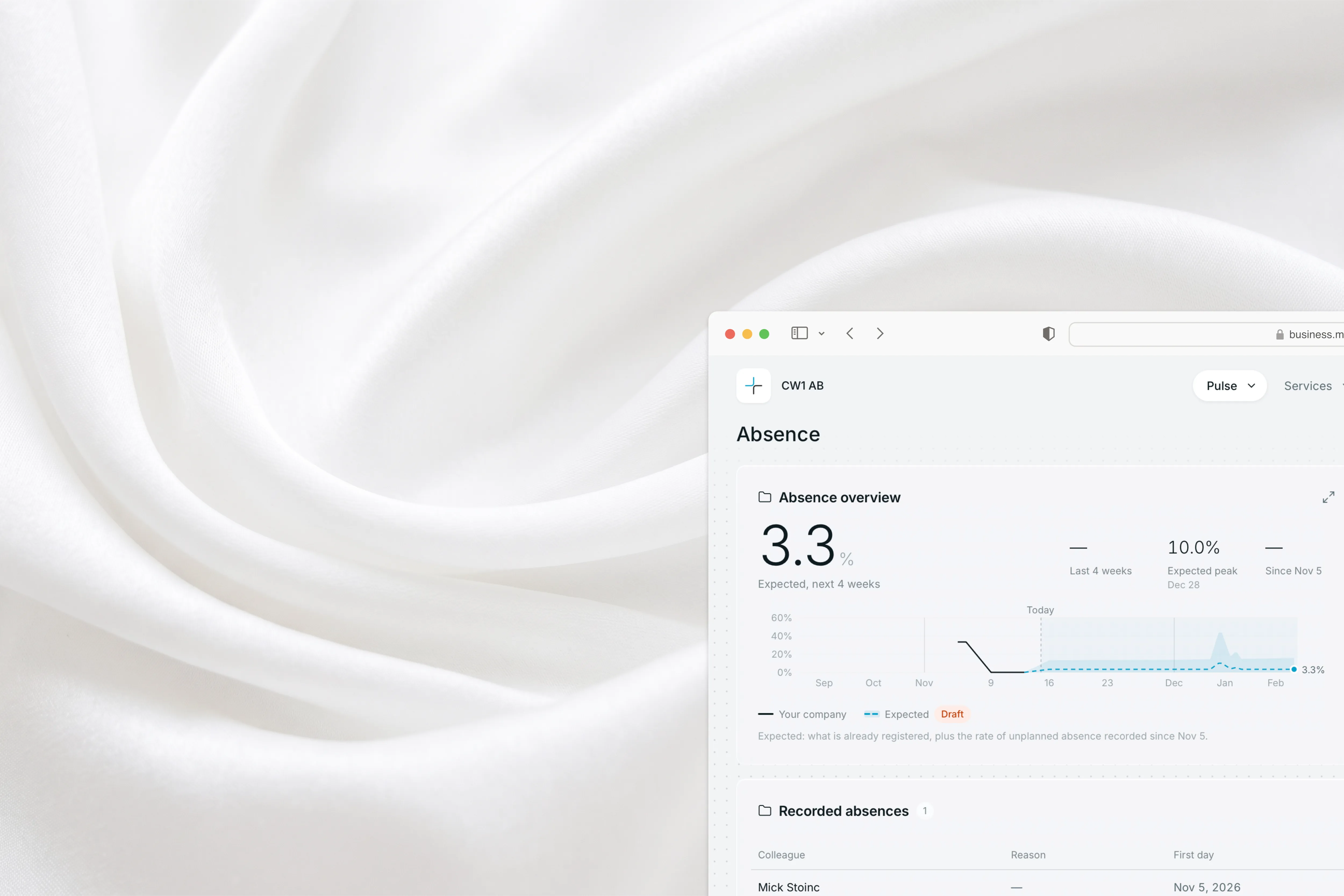
See absence coming
Bridge days, school holidays, flu season: see weeks ahead when absence will peak, and reinforce teams before deadlines are at risk.
Malm for Business: frequently asked questions
- What absence data does the employer see?
- Who is absent, for how long and the leave type: vacation, sick leave, care of a sick child, parental leave and more. Diagnoses are never disclosed.
- How is absence forecast?
- The forecast combines the absences your company records, the calendar of public holidays and bridge days, the time of year and seasonal illness such as flu. It adds advanced psychological analytics: stress, energy and mood across your workforce, always aggregated. The result is always for the company as a whole, never for a person.
- What does sickness absence cost?
- More than most budgets show. Germany's Federal Institute for Occupational Safety and Health (BAuA) puts lost production from sick leave at €134 billion in 2024, at 20.8 sick days per employee. In Portugal, the Ordem dos Psicólogos Portugueses estimates that work-related stress and psychological health problems cost up to €13.3 billion a year. In Sweden, almost half of all ongoing sick-leave cases are psychiatric diagnoses (Försäkringskassan, December 2024).
- What do the four indexes measure?
- Pressure at Work: stress, energy and mood on working days, against the same people's days off. Recovery: how far energy and sleep come back on rest days and after holidays. Vitality: overall workforce wellbeing, derived from Malm vitality scores. Presenteeism: how often people work while unwell. Each index is normalised against the market, set at 100.
- Where do the indexes come from?
- From our patients at Malm, who record how they feel every day, and from advanced analytics we collect on people's daily lives and on major events in each region, such as flu outbreaks, heatwaves or public holidays. Always aggregated, never at the level of one person. The peer group brings together companies of your sector, size and country. Groups of fewer than five people show only the market range.
- What about your busiest periods?
- Malm shows how your last busy periods affected people and warns you in advance which weeks are likely to have more absences. So you can reinforce the team or spread the work before the deadline.
- What do employees receive?
- Malm for their own care: a daily check-in in the Malm app and, on a Malm plan, their own medical team, with secure messaging usually answered the same day. Coming with Malm Intelligence: a company-paid Malm plan for every joined employee, with a doctor who follows their health, a monthly health report and a teleconsultation a month.
- Does the employer see who seeks care?
- No. Messages, consultations and results stay between each employee and their Malm doctor. The employer sees indexes against the market, never who used care or why.
- What does presenteeism cost?
- Often more than absence. In Portugal, presenteeism accounts for €8.9 billion of the up to €13.3 billion lost each year to work-related stress and psychological health problems, against €4.4 billion for absenteeism (Ordem dos Psicólogos Portugueses, 2026). Across ten common conditions, it made up 18–60% of total costs (Goetzel et al., JOEM, 2004). Treatment pays back: every US$1 spent treating depression and anxiety returns US$2.30–3.00 in productivity, or US$3.30–5.70 including health gains (Chisholm et al., The Lancet Psychiatry, 2016).
- How does the measurement work?
- HR selects the colleagues and a closing date. They receive the questionnaire in the Malm app, the Malm portal and by e-mail. Answers are scored with the questionnaire authors' validated method, and a CW1 physician reviews and approves the result before the employer sees it. It is a support tool for the workplace risk assessment, not a diagnosis.
- What does the employer receive?
- How many colleagues answered, and the risk profile of the workplace as a whole, set against a national reference. Never individual answers, scores or who answered. Answering is always voluntary.
- Why do psychosocial risks matter?
- Because they are among the most widespread risks at work. In the EU, 46% of workers report severe time pressure or work overload, and 27% report stress, depression or anxiety caused or made worse by work (EU-OSHA, OSH Pulse 2022). Under the EU Framework Directive 89/391/EEC, employers must assess all risks to workers' safety and health, psychosocial risks included.
- What personal data does the employer see?
- Only what's needed to run the team: who has joined Malm, and each person's absences with the reason, never the diagnosis. For roles where the law requires a medical exam, it also sees whether the person is fit for the job. Everything else reaches the company only as aggregated indexes.
- Is employee participation voluntary?
- Yes. Employees join by invitation and use Malm for their own care. Answering an employer questionnaire is always voluntary.
- How is access governed?
- Every authorised HR user has the same rights, so HR works as one team. There is no manager view. The person who registers the organisation is the account administrator and accepts the customer terms and the data processing agreement (DPA).
Specialized doctors manage the project
The entire initiative is supervised at both European and regional levels by senior medical partners of the CW1 Group.


Dr. Maximilian Bonk
Board-certified neurosurgeon with clinical experience in complex surgical procedures, robotic-assisted techniques, and spinal surgery.
CW1 Senior Partner | Medical Lead


Dra. Erika Fernandes
Oversees CW1 medical operations in Portugal. A pioneer in general medicine.
CW1 Senior Partner | Clinical Director Portugal
OM61150 - Lisboa, Portugal

Dr.Artur Barsumyan
CW1 Senior Partner - CW1 GmbH
Sports Scientists and Performance Coach (cycling, triathlon) working in a variety of high performance environments.
CW1 Senior Partner - CW1 GmbH
Frequently asked questions
The platform, data protection, compliance and early access.
A workforce health benchmarking platform from Malm by CW1. It shows employers what work does to their people through four indexes (Pressure at Work, Recovery, Vitality and Presenteeism), set against comparable employers, without disclosing anyone's health data. Absence and leave management, psychosocial risk assessment and occupational health services sit on the same platform, under CW1's clinical oversight.
HR, people and occupational health leads at employers in Portugal, Germany and Sweden, including accounting and audit firms, law firms, consultancies and office-based teams: organisations where deadlines and client demands weigh on health in ways absence records alone don't show.
In three steps, with no integration project. 1. Register your company with its sector, size and country: the parameters that define your peer group. 2. Invite employees by e-mail. They join in the Malm app and keep using Malm for their own care. 3. Monitor, benchmark and act: follow your four indexes against the market, manage absence and leave, and commission a workplace mental-risk measurement when you need one.
No. The employer never sees individual health data, questionnaire answers or scores, nor who answered. It sees indexes benchmarked against the market, for groups of at least five people; smaller groups see only the market range. Clinical results stay between each employee and their Malm doctor.
Under the EU Framework Directive 89/391/EEC, employers must assess all occupational risks, psychosocial risks included. In Portugal, the workplace measurement supports the psychosocial risk assessment the law requires. Every result is approved by a CW1 physician before the employer sees it. Statutory health surveillance is coming as an on-demand service.
No. It is a support tool for the workplace risk assessment. It uses a validated questionnaire, scored by its authors' method, and a CW1 physician reviews and approves every result. It describes the workplace as a whole, never a person.
Included: Malm Pulse (with sample data for now), absence and leave management, the colleague list and the workplace mental-risk measurement. Coming: Malm Intelligence with company-paid Malm plans, further occupational health services, the Malm Healthy Workplace label and CW1 Advisory.
Malm for Business is in its concept-testing phase. A limited first cohort of employers uses the platform ahead of general release and helps shape what comes next.
Employers in Portugal, Germany and Sweden. Submit your details and the CW1 business team will contact you as places become available.
Published studies and official statistics. As the platform is new, we cite research, not client results. Commitments marked "Malm for Business" describe how the platform works. · BAuA, Volkswirtschaftliche Kosten durch Arbeitsunfähigkeit 2024 (Germany) · Ordem dos Psicólogos Portugueses, O custo do stress e dos problemas de saúde psicológica no trabalho em Portugal, 2026 · Försäkringskassan, sick-leave statistics, December 2024 (Sweden) · EU-OSHA, OSH Pulse: Occupational safety and health in post-pandemic workplaces, 2022 · EU-OSHA, First findings of the Fourth European Survey of Enterprises on New and Emerging Risks (ESENER 2024) · International Bar Association, Mental Wellbeing in the Legal Profession: A Global Study, 2021 · Williams, Lambert, Kesavan et al., Stable Scheduling Study, 2018 · Schneider & Harknett, American Sociological Review 84(1), 2019 · Chisholm et al., The Lancet Psychiatry 3(5), 2016 · Goetzel et al., Journal of Occupational and Environmental Medicine 46(4), 2004

Your next absence peak has a date.
Sick leave cost Germany €134 billion in lost output in 2024; Malm shows you, weeks in advance, when the next peak will reach your company.
Redesigning healthcare
CW1 represents a healthcare approach that listens, evaluates, and takes responsibility. Through our partner clinics and medical practices across Sweden, Germany, and Portugal along with digital programs like Malm we bring doctors and patients closer together, removing the noise in between.
Not sure where to start? Sign up to receive the malm manual: a free guide to understanding your health and the systems that matter most.
CW1 Group Base
CW1 AB, NIF 55925034-10
Torggatan 8, 41105 Gothenburg, Sweden
© CW1 · Stockholm · Frankfurt · Lisbon
- Imprint
- Data Protection
- Cookie policy
- Terms and Conditions